Regulation
What the EU AI Act's transparency rules require from AI in deal software
By the CogniSuite team
What changes on 2 August 2026
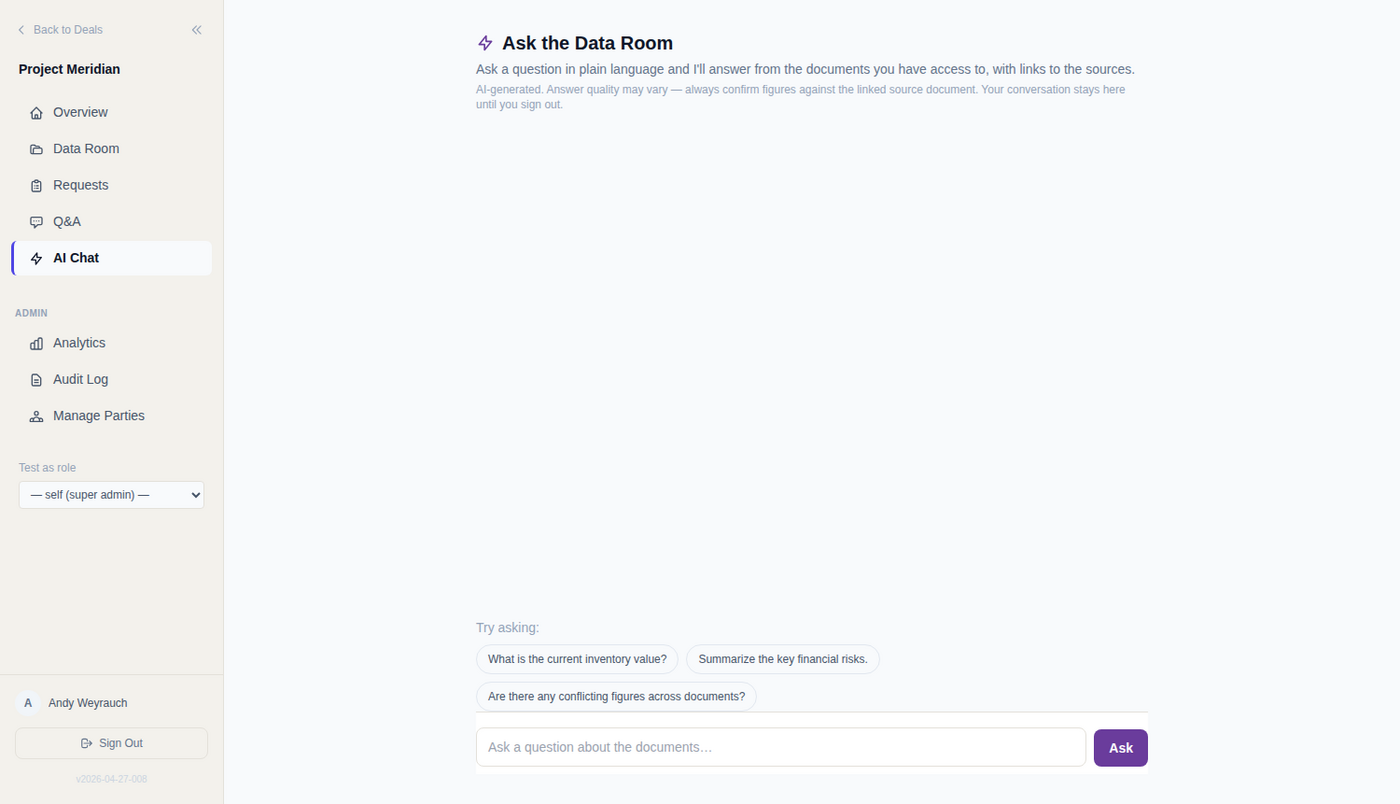
Nothing you have to build. If your deal platform has an AI chat or drafts responses to the other side, that vendor is the provider of an AI system under the EU AI Act, and both Article 50 duties are its own:
- Disclosure. Tell people they are interacting with an AI system.
- Marking. Mark generated content so it can be detected as generated.
Your firm is the deployer. Your job is knowing whether the vendor has done both, and pressing on what the AI can read.
What Article 50 requires
Article 50 of Regulation (EU) 2024/1689 applies whether or not a system is high-risk.
- 50(1) and 50(5). Systems that interact directly with people must be designed so people know they are dealing with an AI system, unless that is obvious in context. The information must be clear and given at the latest at first interaction.
- 50(2). Generated audio, image, video or text must be marked in a machine-readable format and detectable as artificially generated, as far as technically feasible. Assistive editing that does not substantially alter the input or its semantics is exempt.
- Penalties. Article 99(4)(g): up to 15 million euros or 3 percent of worldwide turnover, whichever is higher; the lower for SMEs under 99(6).
The Commission's FAQ on Article 50 is the clearest reference on scope.
Did the Digital Omnibus delay it?
No. Regulation (EU) 2026/1744 of 8 July 2026, in the Official Journal on 24 July 2026, pushed Annex III systems to 2 December 2027 and Annex I systems in regulated products to 2 August 2028. Article 50 was left alone.
The one concession: providers already on the market before 2 August 2026 get until 2 December 2026 for the 50(2) marking duty. A retrofit window, not a deferral. When a vendor says the AI Act is delayed, ask which obligations they mean.
What to ask a VDR vendor
Disclosure is the easy half. What carries risk on a live deal is the AI's reach. In CogniVault:
- One retrieval path. Every AI feature that reads deal documents goes through one function that applies the asking user's folder permissions before a document reaches an answer.
- Per-deal isolation. Each deal is its own database file on its own subdomain, so retrieval cannot reach another deal.
- Counterparty scoping. A reply drafted for the other side may only quote documents that side may read, not what the drafter sees. Ambiguity denies rather than widens.
- Verified quotes. Every citation in a counterparty-facing draft is checked against the real document text on the server before anything is shown. An affirmative draft with no verified citation is replaced with a review template, and drafts stay with the deal team until a person sends.
- Logged. Each AI question is written to the deal audit log. Access model: security.
Article 50 requires none of it. Ask anyway.
What Article 50 does not require
- Naming the model. 50(1) covers the fact of the interaction, not the model, provider or version.
- Consent, or flagging a draft as AI-assisted before a person edited it.
- High-risk classification. Article 50(6) is a saving clause, not a classification trigger, so Article 12 record-keeping does not attach.
- Labelling internal drafts.
Two misreadings. The human-review carve-out sits in Article 50(4), a deployer duty about text published to inform the public, so it does not exempt a provider from 50(2). And the 50(2) exemption covers grammar correction and format conversion, not drafting a diligence answer.
Honest limits
Marking generated text is unsettled. Watermarks are fragile under paraphrase and copy-paste, so any vendor claiming a solved problem is overstating it. The AI Office facilitated a voluntary Code of Practice on transparency of AI-generated content, which the Commission and the AI Board call adequate for demonstrating compliance. Ask whether your vendor signed.
Ours:
- Grounding and anti-injection rules are prompt-level: mitigation, not enforcement. In chat, the citation rule is one of those instructions, not a verifier.
- Retrieval admits any folder a user can read, including view-only and watermarked ones, so an answer can quote a document they cannot download.
- Chat history sits in the browser, so a conversation is not part of the deal record beyond that audit entry.
- Enrichment is asynchronous, so a failed extraction leaves a document viewable but absent from AI retrieval until someone reprocesses it.
- The audit trail is readable by the advisor running the deal, not by all parties.
What holds is code rather than prompt text: per-deal databases, the permission check before retrieval, server-side quote verification. Fair questions for any vendor, including us. This is not legal advice.
General information, not legal, tax or financial advice. For how CogniVault handles security and access, see Security. To see it on a live deal, book a walkthrough.